Content Type: guide
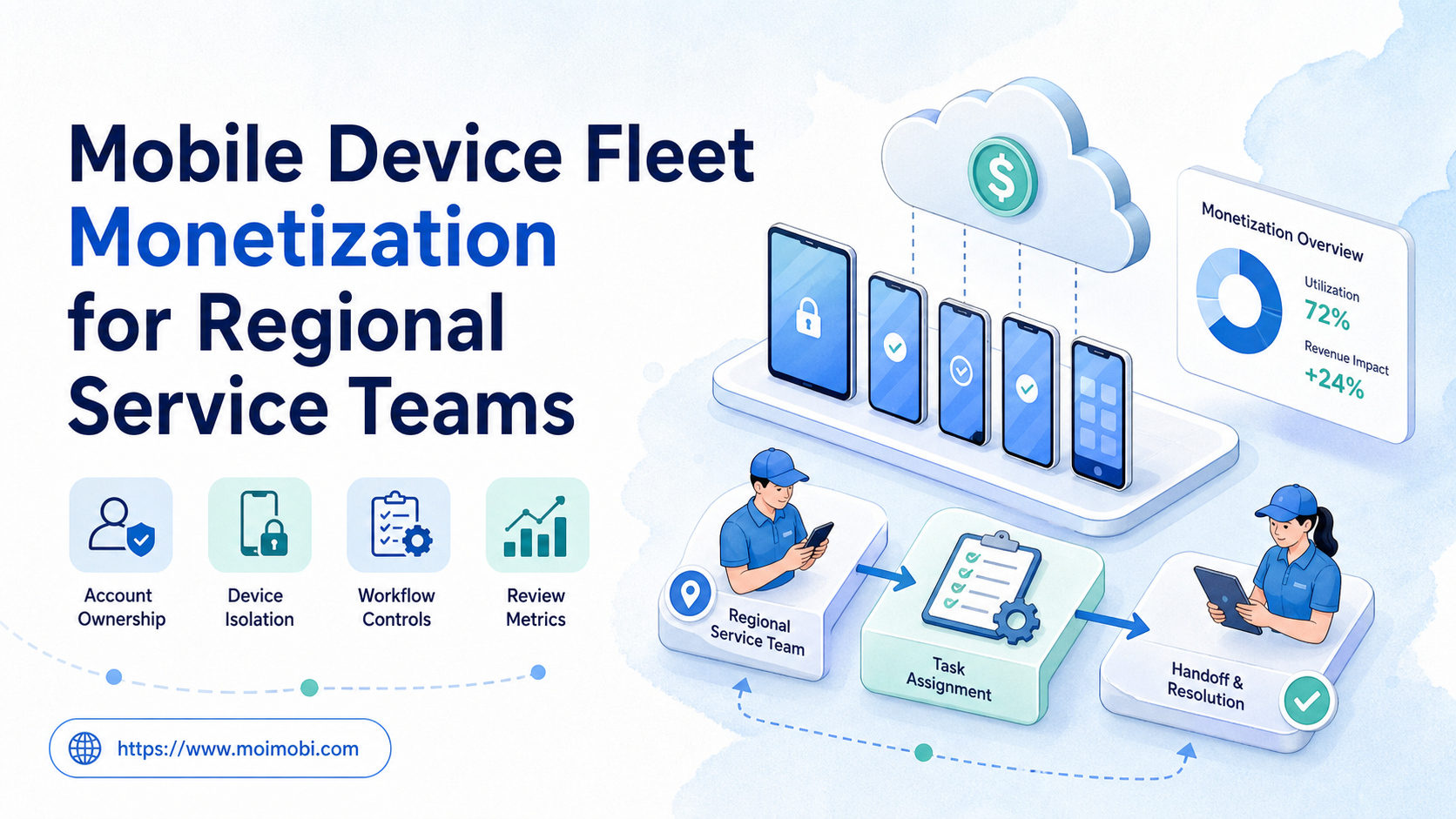
Mobile device fleet monetization is the process of turning a managed set of phones or cloud devices into billable execution capacity for customer work. For regional service teams, the model only works when every device, account, task, and operator has a clear owner.
The goal is not to rent devices loosely. The goal is to sell reliable mobile execution: content publishing, account maintenance, customer replies, lead follow-up, local app checks, and routine mobile workflows. A regional team can package those workflows only when it can prove what ran, who approved it, and what result was recorded.
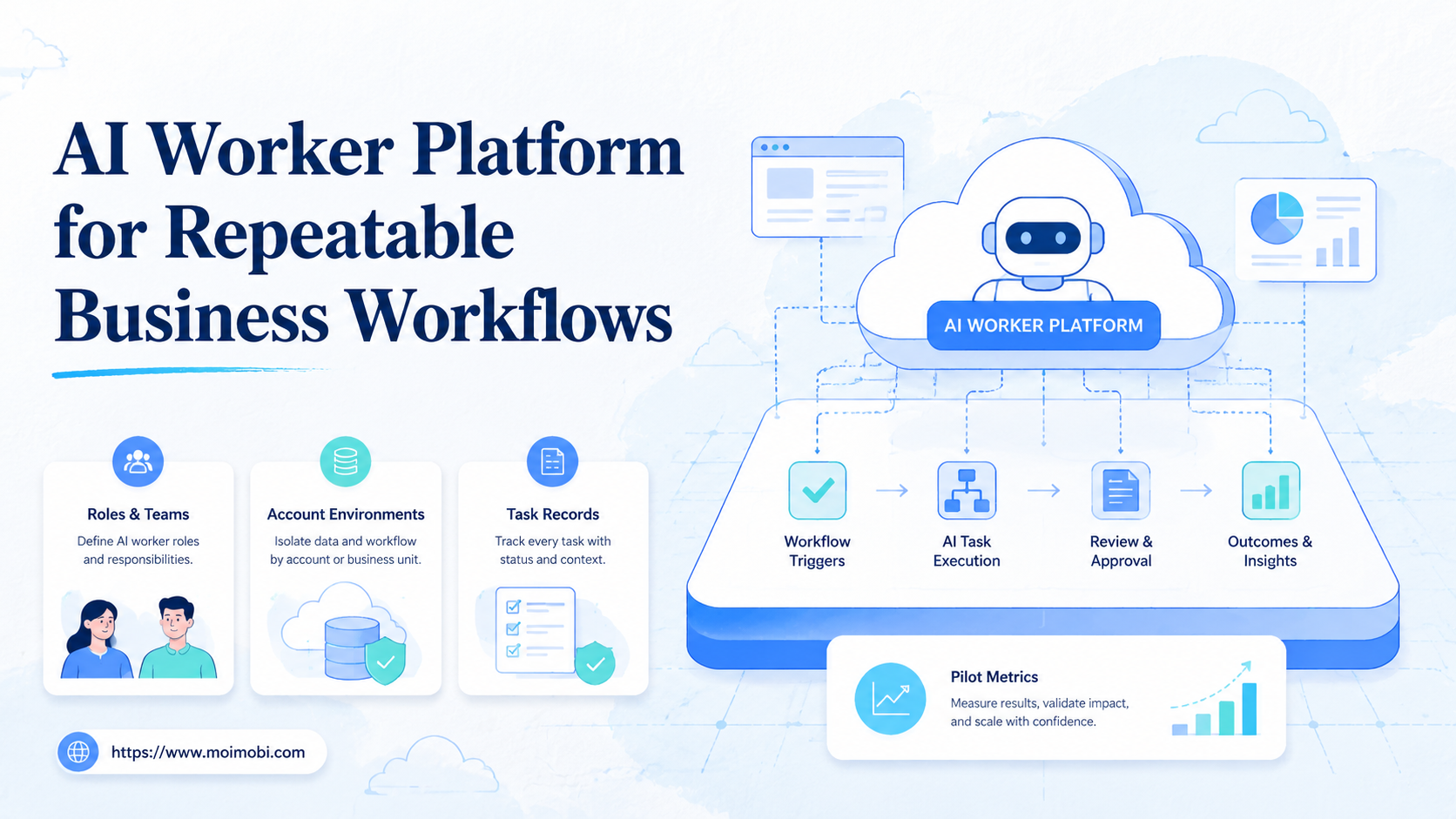
A cloud phone setup can be part of that model, but monetization depends on operations design. The team still needs role-based access, account isolation, work queues, logs, and a recovery process when a task fails.
Key Takeaways
- Mobile device fleet monetization works best when the offer is packaged around workflows, not raw device access.
- Regional teams should assign devices to accounts, tasks, and owners before selling capacity.
- Device isolation, logs, approvals, and retry rules matter more than the total number of phones.
- A small paid pilot is safer than launching a broad mobile farm business immediately.
- The strongest offers usually combine setup, execution, reporting, and ongoing review.
The Core Idea Behind Mobile Device Fleet Monetization for Regional Service Teams
The simple version is this: a service team owns or controls mobile execution capacity, then sells managed outcomes to customers. Those outcomes may include posting approved content, replying to inbound messages, checking local app flows, keeping accounts active, or running recurring mobile tasks.
The weaker version is selling access to a pile of phones. That model can become hard to defend because the buyer still has to build SOPs, manage accounts, track errors, and review results. A regional service team usually has more pricing power when it sells an operating process instead of hardware availability.
For example, a local agency may serve restaurants, retail stores, training centers, or cross-border sellers in one region. Each customer needs mobile social accounts, messaging apps, content tasks, and reply handling. The agency can package a monthly service around managed mobile work if it has a controlled device pool and a clear service boundary.
| Monetization model | What the customer buys | Main operational risk |
|---|---|---|
| Device access | Access to phone capacity | Customer still owns the workflow problem |
| Managed execution | Published tasks, replies, checks, and reports | Provider must keep strong logs and approvals |
| Hybrid service | Device environments plus SOP support | Scope can drift without written boundaries |
Android Enterprise describes business device management as a way to manage devices and apps for organizations. That does not define a monetization model, but it supports the basic operating principle: business devices should be assigned, governed, and reviewed. See Android Enterprise for the broader device management context.
Why Teams Search for Mobile Device Fleet Monetization
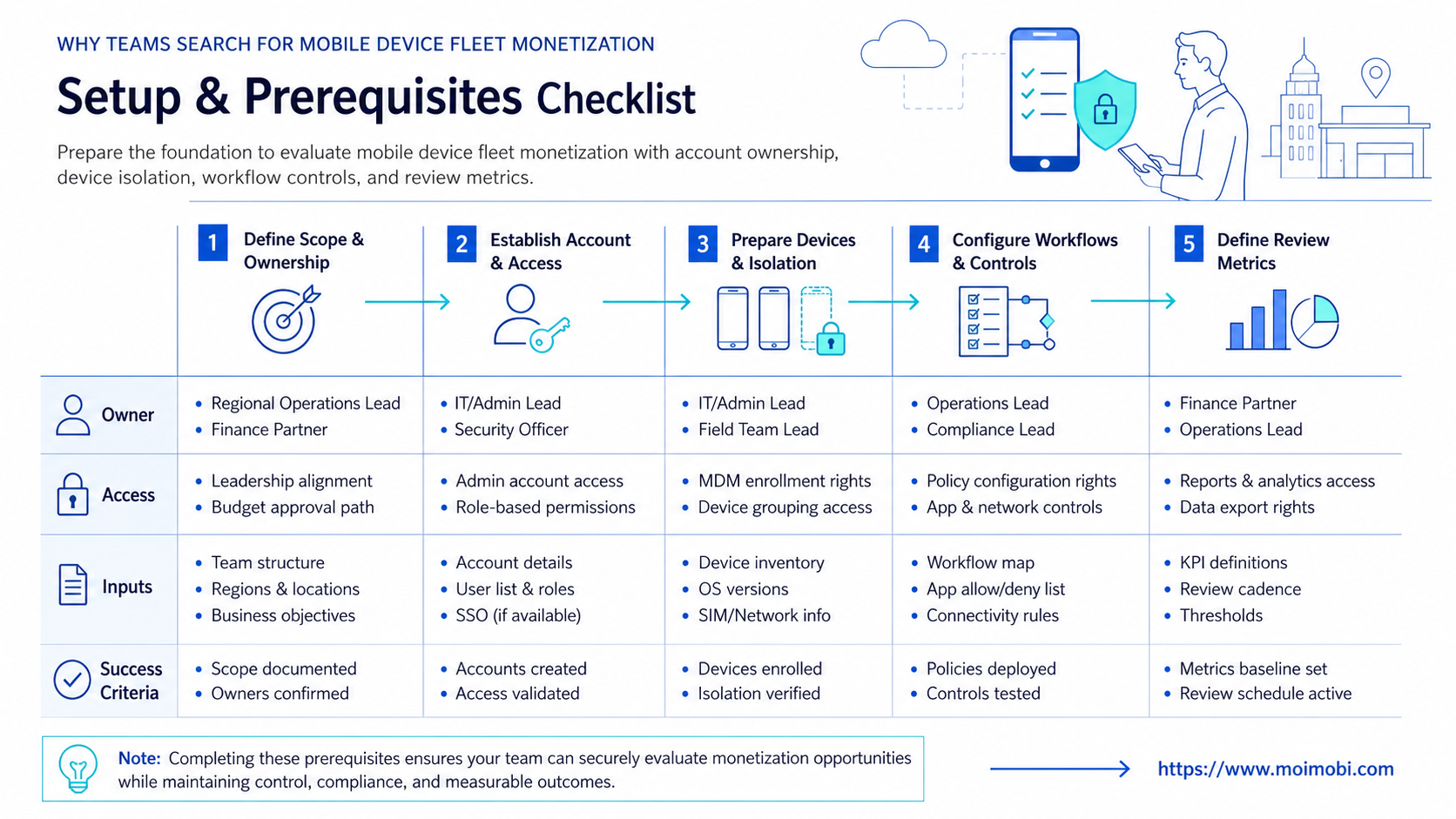
Teams usually search for this topic because they already feel the limit of manual mobile work. They may have phones on desks, staff switching between accounts, or customers asking for repeatable social and messaging operations. The question becomes: can this capacity become a service line?
Use a three-part filter before building the offer:
- Demand: customers repeatedly ask for mobile execution, not just advice.
- Control: the team can assign accounts, devices, people, and approvals.
- Proof: the team can show task history, status, and review notes.
Without demand, the fleet becomes unused inventory. Without control, the work becomes messy. Without proof, the customer cannot tell whether the service is improving operations.
Device-fleet services also need a clear distinction between testing and production work. AWS Device Farm presents cloud-based access to real mobile devices for app testing workflows, which is a useful comparison point for teams designing controlled device usage. See AWS Device Farm documentation. A service operation may not be a test lab, but both models benefit from structured device assignment and result tracking.
Who Benefits Most and In What Situations
The common mistake is assuming any team with many phones can start a mobile farm business. A better fit is a team that already understands a narrow customer workflow and can repeat it with low confusion.
Regional agencies benefit when they serve customers with similar needs. A team focused on local merchants can standardize review replies, content posting, profile checks, and messaging follow-up. A cross-border service team can standardize social account maintenance, campaign handoff, and app-based customer support.
The model is weaker when every customer needs a different process. Custom work increases training, QA, recovery effort, and support tickets. That can still be profitable, but it should be priced like managed operations, not cheap device access.
Preflight checklist
- Define the customer segment before buying more devices.
- Separate live accounts, test accounts, and backup accounts.
- Decide which tasks require approval before execution.
- Create one owner for each customer account group.
- Keep device, account, proxy, workflow, and operator records together.
- Set a stop rule for failed logins, repeated task errors, or unclear customer instructions.
Teams that already need account separation should evaluate multi-account mobile operations before scaling capacity. The commercial value comes from cleaner execution, not from counting devices.
How to Evaluate or Start Using Mobile Device Fleet Monetization for Regional Service Teams
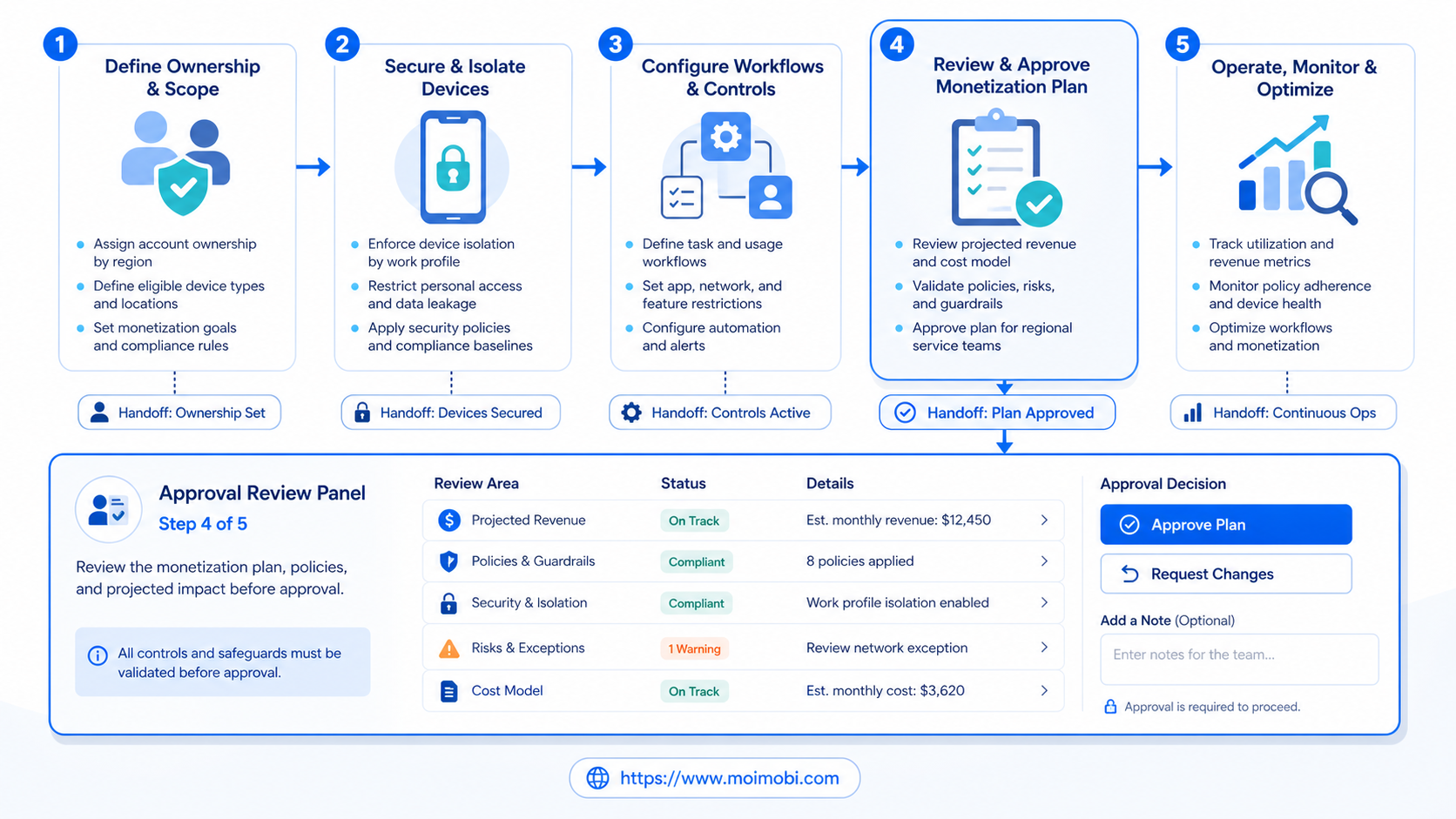
Do not start by selling the largest package. Start by proving one repeatable paid workflow with a narrow customer group. The first pilot should expose pricing, staffing, review workload, and failure recovery.
- Pick one service package. Choose content publishing, inbox follow-up, account maintenance, or app checks. Do not bundle everything in the first offer.
- Assign environments. Map each customer account to a device environment, owner, and task queue.
- Write the approval rule. Decide what can run automatically and what needs human confirmation.
- Record every task. Capture task type, account, device, operator, start time, status, and result.
- Review weekly. Inspect failed tasks, customer feedback, time spent, and repeated manual corrections.
- Price after the pilot. Use actual workload to decide whether to charge per account, per workflow, or per managed package.
MoiMobi fits this stage when a team needs regional task execution controls rather than scattered hand-operated phones. The platform layer should make task execution easier to assign, pause, review, and repeat.
Packaging the Pilot Into a Service Offer
A pilot becomes easier to sell when the package has a narrow promise. Avoid a vague offer such as "mobile operations support." Use a defined service line that names the task, account count, review cadence, and reporting format.
One practical starter package is a managed social execution package for local merchants. The team receives approved content, checks account status, runs posting tasks, records replies that need review, and sends a weekly exception report. This is easier to operate than an open-ended request queue.
A second package is mobile account maintenance for cross-border sellers. The service team checks assigned accounts, keeps task records, handles routine app-side updates, and escalates anything that needs human judgment. The offer is still operational, but it has a clearer boundary than general consulting.
| Package field | Define before selling | Why it matters |
|---|---|---|
| Account scope | Which customer accounts are included | Prevents unsupported account sprawl |
| Task scope | What the team will and will not execute | Keeps support work measurable |
| Approval rule | Which actions need customer or manager review | Reduces avoidable mistakes |
| Reporting cadence | Daily log, weekly summary, or exception report | Makes value visible to the buyer |
The first paid version should be modest. Sell enough work to test operations, but not so much that the team hides broken process behind manual effort. If the service requires constant custom explanation, the package needs a smaller scope.
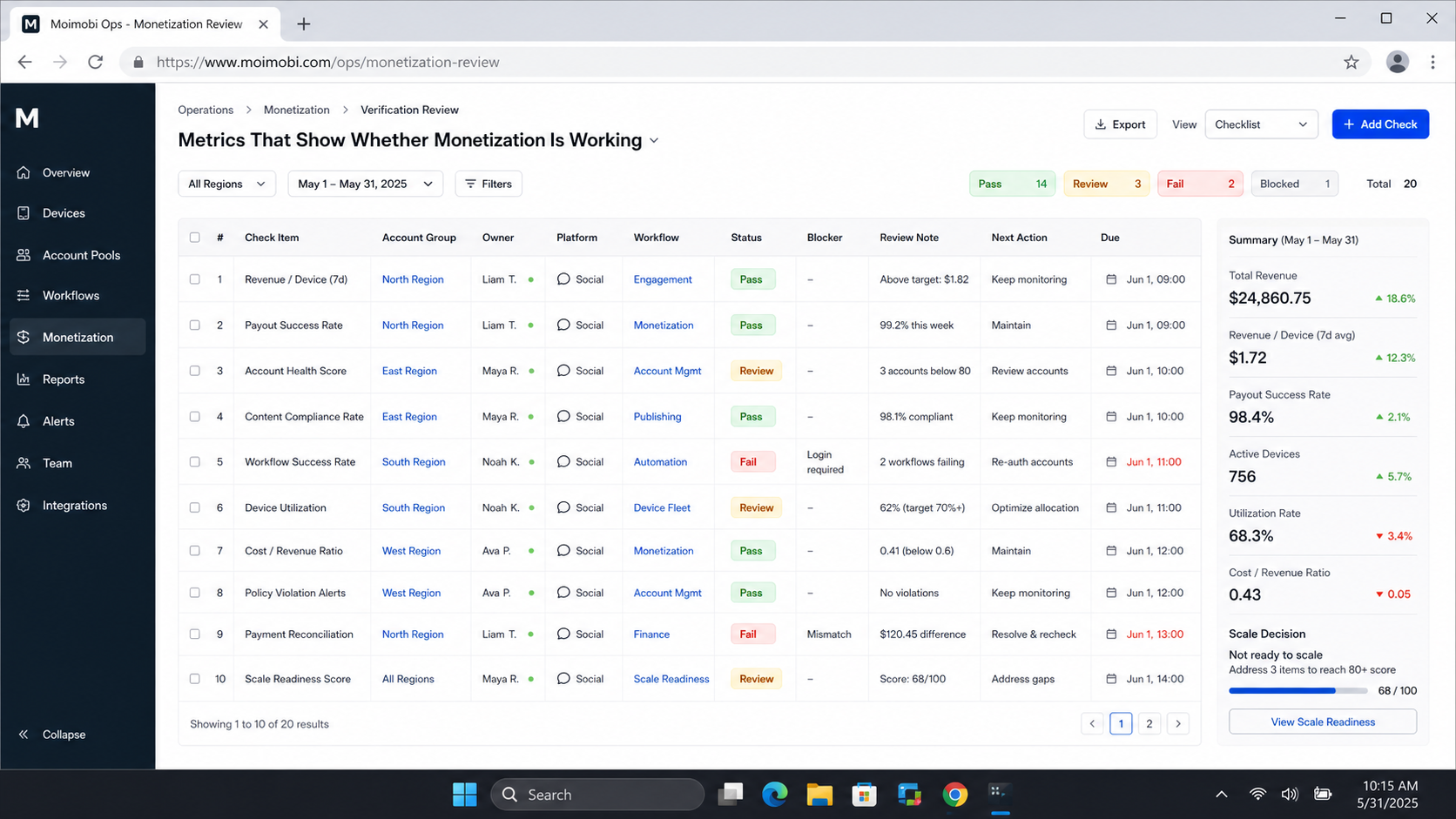
Metrics That Show Whether Monetization Is Working
Revenue alone is too late as a signal. A regional service team should review operating metrics before adding more customers or devices. The useful metrics are simple: completed tasks, blocked tasks, average review time, customer clarification count, repeated failure reasons, and operator handoff quality.
Margin review should also separate device cost from support cost. A device pool may look affordable until staff spend hours fixing unclear instructions, moving accounts, or explaining missing records. Track the human time around the device fleet, not only the device bill.
Use a short weekly scorecard:
- How many assigned tasks finished without manual rescue?
- Which failure reason appeared more than once?
- Which customer instructions were unclear?
- Which accounts needed owner review?
- Which package consumed more staff time than expected?
- Which workflow can be standardized next week?
This scorecard turns mobile device fleet monetization into an operating discipline. It also helps managers decide whether to add devices, narrow the package, change pricing, or reject customers whose workflows cannot be standardized.
Mistakes That Reduce Results
The biggest mistake is treating monetization as a device-count problem. More phones can increase capacity, but they also increase assignment work, support work, and review work. Capacity only becomes profitable when the team can run it without constant clarification.
Another mistake is mixing customer environments. If two customers, two operators, and several task types share the same loose setup, the team may struggle to explain what happened after an error. Clean isolation makes customer support and internal review easier.
Good fit
- Repeated mobile tasks with similar customer needs
- Clear account ownership and approval rules
- Task logs that managers can review
- Defined recovery paths for failures
Poor fit
- One-off work that changes every day
- No account or device assignment records
- Customers expect unlimited tasks for a low fee
- Operators manually improvise every workflow
Teams building a phone farm alternative should also avoid copying old device-farm habits. A modern service should be judged by workflow clarity, not by racks, cables, or raw phone counts.
Verification Checklist Before Scaling
A pilot is ready to scale only when the service can survive routine handoff. That means another operator can inspect the record, understand the next step, and continue work without asking the original operator to explain everything.
Check these points before adding customers:
- Each customer account has a named owner.
- Each account has a known environment and task type.
- Approvals are visible before sensitive actions.
- Failed tasks have a reason, not only a failed status.
- Reports show work completed, work blocked, and next actions.
- Customer instructions are stored in a reusable place.
- The team knows which work is profitable and which work drains time.
If the workflow depends on one person remembering details, it is not ready to scale. If the workflow can be assigned, reviewed, and repeated, the fleet can support a more serious service package.
Frequently Asked Questions
What is mobile device fleet monetization?
It is the process of turning managed phones or cloud devices into billable execution capacity. The best model usually sells workflow outcomes, not just device access.
Is this the same as a mobile farm?
Not exactly. A mobile farm often describes a pool of devices. Mobile device fleet monetization focuses on how that pool becomes a controlled service.
What should a regional service team sell first?
Start with one repeated workflow. Content publishing, account checks, customer replies, and lead follow-up are easier to package than a broad custom service.
How should pricing be decided?
Use pilot data. Track time, failures, approvals, support questions, and customer value before choosing a monthly or per-workflow price.
Does the team need physical phones?
It depends on the workflow. Some teams use physical devices, some use cloud devices, and some combine both. The key requirement is controlled execution and clear records.
What makes this model hard to scale?
Unclear ownership, mixed customer environments, missing logs, and custom work without scope control make scaling difficult.
How does MoiMobi help this workflow?
MoiMobi helps teams organize mobile execution environments, account workspaces, task controls, and review loops. It is better understood as execution infrastructure than device rental.
Conclusion
Mobile device fleet monetization works when the team sells a managed operating system for mobile work. The priority order is simple: define the customer workflow, assign environments, record task execution, review failures, then price the service from real workload.
Do not scale the fleet before the process is visible. A small regional team can build a stronger service by proving one repeatable package first. Once the workflow is easy to assign, pause, audit, and report, device capacity becomes a business asset instead of an operational burden.